

Your Guide To Road Markings
It’s not just road signs you have to lookout for, the lines on the road mean something and they are often telling you something important or something you need to do. Learning how to recognise and respond to these markings is a key part of becoming a safe and confident driver, and something that is covered in detail during intensive driving lessons in Norwich, where learners can apply this knowledge in real-world driving situations.
What do the road markings mean?
There’s many different styles of road markings, such as double yellow lines, single red lines, dashed white lines (to name a few!), and they’re important to keep an eye on and keep in mind when driving, so you can make sure you are driving safely and correctly.
We’ve shared below some of the most common and most important line markings to remember.
Across the road
Stop line at traffic signals

A white line across the road will appear mostly with traffic lights, and it’s important to stop before the line if directed to do so by the accompanying traffic signals, or a member of the police. Also seen at police control areas.
There may also be a cycle box at the advanced stop line (ASL). Remember to stop before entering this cycle box.
Stop lines with stop signs

The marking here is a reminder to stop and give way to oncoming and passing traffic before entering a junction, often without traffic lights. These are used where visibility may be more limited than a typical road junction.
Give way to traffic on major roads

Very commonly seen at major junctions, these white double broken lines tell drivers that they need to give way to traffic on major roads, drivers won’t always have to stop at this line – but they must keep an eye out for any hazards and traffic crossing their path.
These markings can also appear at mini roundabouts.
Give way to the right
At roundabouts and mini-roundabouts, the single broken white line indicates to drivers that they have to give way to the right.
The lines at mini-roundabouts are chunkier than larger roundabouts.
Along the road
These road markings are painted along the carriageway, to the side of the road.
Edge lines

These are white in colour, and appear on the left hand side.
They can sometimes be ribbed, to alert drivers when they are straying too close to the edge of the road and are known as raised profile edge lines.
These mark the edge of the carriageway, and act as a helpful guide to maintain a safe and lateral position on the road. These are often used as a safety measure, in locations which may be hit regularly by fog and mist, or at sudden changes of road width and on unlit sections of carriageway.
Centre lines, hazard warning lines and lane lines
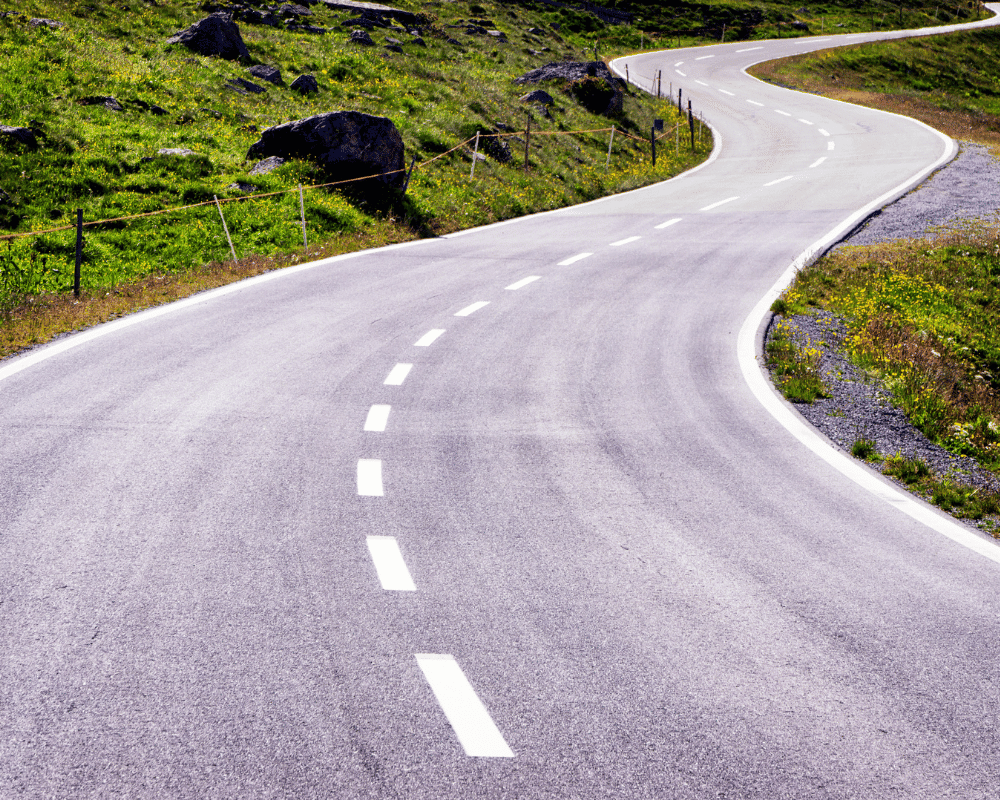
A broken white line marks the centre of the road. When this line lengthens, and the gaps shorten, it means that there is a hazard ahead. Do not cross this unless you can see the road ahead is clear and you wish to overtake or turn off.
These are typically the most common markings you will encounter when driving.
Similarly used are lane dividers (or lane lines) which consist of short, broken white lines which you should drive within. These are typically used on wider roads, to safely divide driving space such as dual carriageways and motorways.
Double white lines

These can appear in a range of different ways – such as a broken white line on your side of the road, where the line nearest you is solid, and where both lines are solid.
When driving along the road and the double white lines where the nearest line is broken, rule 128 of the Highway Code says you may cross the lines to overtake when it is safe to do so and you can complete the manoeuvre before reaching a solid white line on your side.
If the road has double white lines where the nearest line is solid, rule 129 of the Highway Code says you must not cross or straddle these lines unless it is safe and you need to enter a property on the side of the road or a side road.
If both lines are solid, you must not stop at any point. They are also used in areas where overtaking visibility is restricted.
White diagonal stripes

Road markings such as the white diagonal stripes are used to separate lanes or to protect traffic turning right. According to Rule 130 of the Highway Code, if the area is bordered by a broken white line you shouldn’t enter unless absolutely necessary and it is safe to do so. If the area is marked by chevrons, and bordered by solid white lines you absolutely must not enter except in the case of an emergency.
Share this story
Help us to help you!
Was this content helpful?
Your feedback is greatly appreciated, to help us provide beneficial articles in the future.
